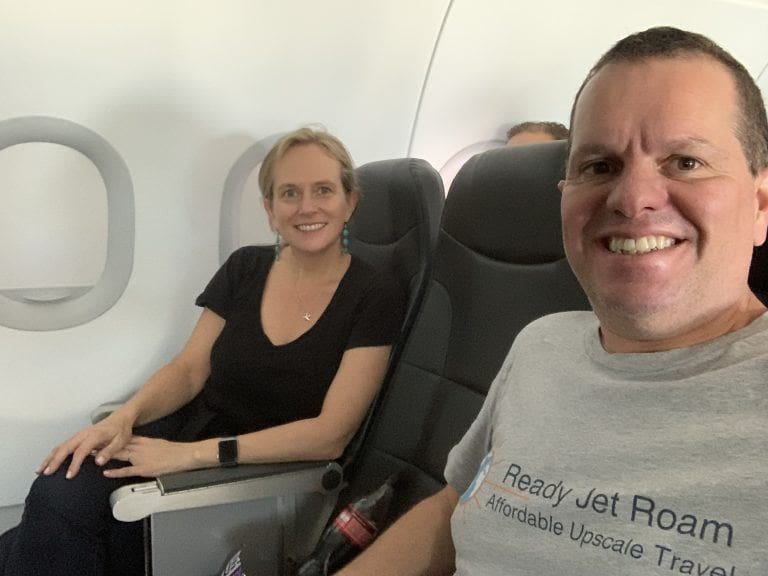


Twelve hours after we landed in Vienna, my husband couldn’t walk.
Matt had said his back felt sore when we changed planes in Frankfurt. We put it down to the flight. By the time we got to Vienna it was worse, and then his leg simply stopped working. We were five thousand miles from home, in a country where we didn’t speak the language, and we had no idea what was happening.
We took a cab to our Airbnb assuming it was a pinched nerve or something and that it would get better.
It didn’t. He couldn’t sleep. He couldn’t sit, stand or lie down without pain.
So I went to the US State Department website, found their list of English-speaking doctors in Vienna, and started working through it. Most didn’t answer. One did. He was calm and kind and saw us the next day, sent Matt straight for an MRI, and came back with the answer: a severe spinal hernia that had wrapped itself around a nerve. That was why the leg had stopped working. Without surgery, he said, the nerve damage could become permanent.
He scheduled the operation for two days later and found us a hospital bed, an operating room and a consulting spinal surgeon. The surgery worked. The relief was immediate. Matt was in hospital for three days, and then we canceled everything, rented an apartment in Vienna for a month, and he started daily physical therapy. By the end of it we even made it to a ball, Matt in a back brace.
Now the part I actually want to talk about.
The total expense was almost $30,000. Over $22,000 for the surgery and hospital plus over $7,000 in additional expenses including housing, transport, physical therapy, etc.
We paid it all on a credit card while we waited to find out whether anyone would give it back to us. Our US health insurance eventually covered most of the surgery itself, about $18,000, and only because it qualified as an emergency. It didn’t cover anything else.
But our travel insurance covered the rest. The coinsurance and deductibles on the US policy, four weeks of physical therapy, the non-refundable flights and accommodation we had to abandon, and the month of apartment rent in Vienna while he recovered. Another ten thousand dollars, give or take.
We later found out that if our US health insurance had refused the surgery, the travel policy would’ve covered that too.
I’m not going to tell you insurance is exciting. I’m going to tell you that we’ve filed three claims with our travel insurer, and I know precisely what each one paid, because I have the paperwork.
What the two kinds of insurance actually do
This trips people up constantly, and the distinction matters more than almost anything else here.
Health insurance is about your body. Doctor visits, checkups, surgery, chronic conditions, cancer. Some policies extend abroad. Most don’t, or do so with enough exclusions that you should read yours rather than assume. Ours covered Matt’s surgery in Vienna, but only because it was a genuine emergency.
Travel insurance is about the trip. Delayed flights, lost bags, stolen possessions, cancellations, and, importantly, emergency medical care while you’re away from home. Its medical benefits are usually built for accidents and emergencies rather than ongoing care, and they’re usually capped.
You aren’t choosing between them. They cover different things and they fail in different places. What happened in Vienna is the clearest illustration I have: one policy paid for the operating table, the other paid for everything that happened around it.
If you already have decent health insurance at home, the honest question isn’t “should I buy health insurance for this trip.” It’s “what happens to everything my health plan won’t touch.” In Vienna that was most of a month of physical therapy, an apartment, and every booking we had to abandon. That’s what travel insurance is for.
What your credit card actually covers, and the number that should worry you
Every time I write about this, somebody tells me their card has them covered. So let me use the best case.
The Chase Sapphire Reserve carries the strongest emergency medical benefit of any mainstream US travel card (and it also has a big annual fee), which makes it the fairest possible test. Here’s what it actually provides, as of August 2026. Trip cancellation and interruption up to $10,000 per traveler and $20,000 per trip. Trip delay of $500 per traveler after six hours. Lost luggage up to $3,000 per traveler, though with a $500 sub-limit on jewelry and electronics. Baggage delay at $100 a day for five days. Primary rental car coverage up to $75,000. Emergency evacuation and transportation up to $100,000.
That’s a genuinely good package and I’m not going to pretend otherwise. If your bag vanishes or your flight strands you overnight, your card is quietly excellent.
Then there’s the line that matters.
Emergency medical and dental: $2,500, with a $50 deductible, only when you’re 100 miles or more from home, and only on trips of five to sixty days.
Matt’s medical bill alone was over €22,000, comfortably north of $23,000. The card with the best medical benefit on the market would’ve paid $2,450 of that, and only if the trip fell inside its eligibility window.
That isn’t a criticism of the card. It’s a category error that a lot of sensible people make. A credit card’s travel protections are built to make a ruined trip less expensive. They aren’t built to absorb a medical emergency in a foreign hospital, and the limits say so plainly if you read them.
Two other things worth knowing. Card benefits generally require you to have paid for the trip with that card, so a flight booked on points from a different program may not be covered at all. And card coverage doesn’t include the pre-existing condition waivers a standalone policy can offer, which is its own subject and one I cover extensively in a separate article.
Check your card’s benefit guide. Then check the medical line specifically. If the number has four digits, you have trip protection, not medical coverage.
The claim that paid, and the claim that disappointed
In October 2021 we were in Paphos, Cyprus for a conference. On the last night we packed our carry-ons, locked up, set an alarm for our early departure and went to sleep. The apartment was on the ground floor and the only air conditioning was in the bedroom, so we shut the bedroom door, turned it up, and slept soundly.
We woke up to find our things rearranged. Our laptop backpacks, which had been packed and sitting on the floor, were open on the sofa. A window and its wooden shutters, which we’d closed and locked, were open and broken.
We’d been burgled while we slept in the next room. It remains the most frightening thing that has happened to us in all our years of travel, mostly because of what could’ve happened if one of us had woken up.
They took both laptops, cash, Matt’s AirPods, two pairs of sunglasses, three pairs of earrings and my wallet. They left my passport and all my credit cards, and our phones were charging beside the bed. Best guess is they didn’t want anything traceable back to us. The one thing I took from that night is that what you actually need to travel is your phone and your passport. Everything else is replaceable, and now I know roughly at what rate.
We filed the claim on December 11 and had our explanation of benefits and our checks by January 31.
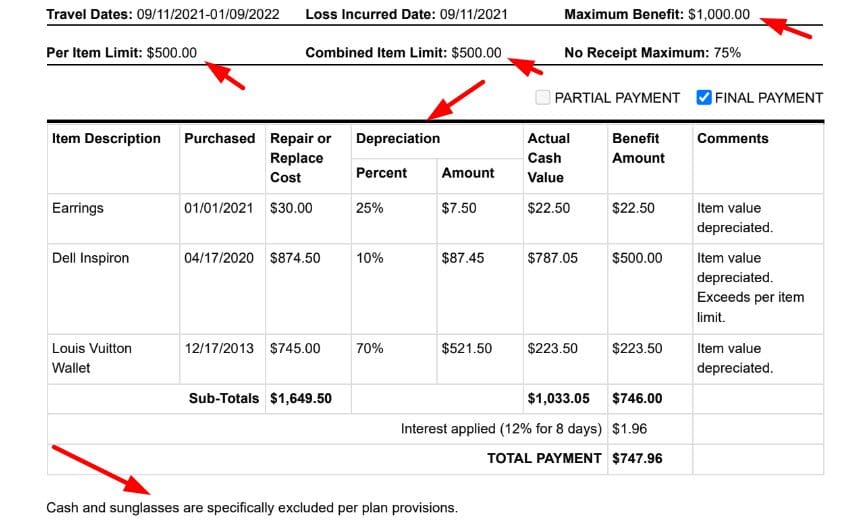
Here’s what the explanation of benefits taught me, and it’s the most useful thing in this entire article:
• There was a $500 per-item limit. My laptop was worth considerably more than that.
• There was a depreciation schedule applied first. They knocked ten percent off the laptop for age, and then applied the $500 cap to what was left.
• Sunglasses and cash were excluded outright. Not reduced. Excluded.
• There was a $1,000 maximum benefit, which my losses didn’t reach anyway after the exclusions.
We reckon the burglars took about $3,000 of our things. We were paid $1,376.81. We recovered roughly 45 percent, and the policy performed exactly as written.
That’s the point. Nothing went wrong with that claim. I simply hadn’t read the limits, and the limits are the policy. The headline number on a travel insurance page is the ceiling on the worst possible day. The per-item caps and the exclusions are what you’ll actually meet.
Read the schedule of benefits before you buy, not after you’re burgled.
What filing a claim is actually like
Our first claim was in London in November 2019, where we’d brought a crowd of friends over for Matt’s birthday. Partway through the Harry Potter studio tour I had to sit down, because the pain I’d assumed was a sinus problem had become something I couldn’t walk through. My face swelled dramatically. It turned out to be an abscess that needed surgery, and I was in hospital and out again in time for the birthday party, which I count as a win. The follow-up appointments meant staying in London a few extra weeks and canceling our onward plans.

So I filed. I submitted on December 4. On January 7 they told me documents were missing. I sent those. On February 13 they told me documents were still missing. I sent those too. Then the pandemic arrived and everything slowed down. On April 9 the surgery payment came through at $2,645.33, and on May 20 the trip interruption payment at $984.31, covering the canceled flight, the canceled rental car and the extra London accommodation.
So: five and a half months, three rounds of paperwork, and payment exactly as the policy said.
What they wanted, and what I’d now gather before leaving the country: receipts and proof of payment for every medical expense, evidence of your travel dates, the credit card statements showing you paid for the trip, a report from the practitioner who actually treated you confirming the diagnosis and treatment, and a statement from your regular doctor at home.
That fourth one is the one that catches people. Get the treating doctor’s written report before you leave the country. Requesting medical records from a foreign hospital three months later, in a language you don’t speak, is a completely different task from asking the doctor in front of you for a letter while you’re still standing there.
Same lesson from Cyprus: we needed a police report, and Cypriot police wouldn’t give us a copy. The insurer had to call them directly, which added weeks.
Could you just pay cash instead?
Sometimes, honestly. Matt once limped into a hospital in Chiang Mai with an ankle he had hurt weeks earlier. He walked in at 4:29 in the afternoon and walked out at 5:09, diagnosed, prescribed and paid up, for well under a hundred dollars. Excellent care, no drama. Healthcare in much of the world costs a fraction of what it costs in the United States, and for a sprain or an infection, paying cash abroad is often cheaper than the paperwork is worth.
That isn’t what insurance is for. Insurance is for the €22,000 day, the version of the trip where it isn’t a sore ankle but emergency surgery and a month of recovery and every plan you made evaporating at once. You can’t know in advance which trip you’re on.
One trap worth naming if you’re looking at an annual policy rather than a per-trip one. We bought an annual plan years ago that looked like extraordinary value, and it was, right up until we read that no single trip could last longer than ninety days. Irrelevant for a two-week holiday. If you’re planning a longer stretch, that clause is the first thing to look for.
Which policy we actually carry
We use World Nomads. That isn’t a neutral statement, because I have three settled claims with them and I’ve told you exactly what each one paid, including the one that paid less than I hoped. They handled all three as their policies said they had, the documentation demands were real, and the money arrived.
SafetyWing is the other one we looked at seriously. It was actually our first choice on the strength of what they were building, and we only went elsewhere because of a residency rule that had nothing to do with the quality of the cover.
What I’d genuinely tell you to do is get quotes from more than one. Run World Nomads, SafetyWing and Travelex for your own dates and your own age, then compare their schedules of benefits rather than their premiums. The per-item caps and exclusions vary more than the price does, and after Cyprus I care a great deal more about the schedule than the headline.
This article is about what the policy pays. My Travel Safety Guide tells you exactly what to do when things go wrong.
When Matt’s leg stopped working in Vienna, the question wasn’t what our coverage limits were. It was who to call, in what order, in a country where we didn’t speak the language.
The Smart Woman’s Guide to Safer Travel has a full chapter on when things go wrong. What to do in a genuine medical emergency and who to call first. How to find English-speaking specialists abroad, which is exactly how I found the doctor who got Matt into surgery. What your insurer’s 24/7 line will actually do for you, including coordinating billing so you aren’t putting €22,000 on a credit card the way we did. What to do if you’re robbed. And a section on assault that I included because if you’re ever in that situation you deserve to know what to do rather than work it out alone.
It comes with eight grab-and-go checklists plus a fill-in emergency contact card you keep in your wallet.
Frequently asked questions about travel insurance
Do I really need travel insurance for a two-week trip? The length of the trip has nothing to do with it. Matt’s emergency happened twelve hours after we landed. A two-week trip has the same bad day in it as a two-month one, and it costs the same amount to treat.
Isn’t my credit card enough? For a delayed bag or a canceled flight, often yes. For a medical emergency, no. The best travel card in the country caps emergency medical at $2,500. Check your own card’s benefit guide and look at that specific line.
Does my regular health insurance work abroad? Sometimes, partially, and usually with exclusions. Ours paid for the surgery in Vienna and nothing else, and only because it was an emergency. Call your insurer and ask specifically what happens if you’re hospitalized outside the country. Ask them to put the answer in writing.
What’s the difference between travel insurance and travel medical insurance? Travel insurance covers the trip: cancellations, delays, luggage, theft. Travel medical insurance covers your body while you’re away. Most comprehensive travel policies include both, but the medical benefit is capped, so the number is what matters rather than the label.
How much does it actually cost? Less than people expect and less than one nice dinner out on the trip you’re insuring. I’m not quoting a figure because pricing depends on your age, your destination, your trip length and your coverage, and any number I printed here would be wrong within a year. Get quotes from two or three insurers like World Nomads, SafetyWing and Travelex
What if I have a health condition already? That’s a real question with a real answer, and it deserves its own article rather than a paragraph here. The short version is that timing matters enormously and most people find out too late.
How long does a claim take? Our London claim took five and a half months and two rounds of chasing missing documents, partly because the pandemic hit in the middle of it. Our Cyprus claim took about seven weeks, because by then we knew what they’d ask for. Neither was hard. Both were slow.
What do they ask for? Receipts and proof of payment, evidence of your travel dates, credit card statements for the trip, a report from the doctor who treated you, and a statement from your doctor at home. For theft, a police report. Gather the medical report before you leave the country and the police report before you leave the city.
Is it worth claiming for something small? Yes, and it’s easier than you think. Matt’s small hospital bill in Thailand went through on an annual policy we’d almost forgotten we owned. We got an email confirming it would be reimbursed the day after we filed.
The bottom line
I’ve filed three claims with World Nomads. One paid $3,629.64 across two payments and took five and a half months. One paid $1,376.81 against about $3,000 of stolen property, because of caps and exclusions I hadn’t read. One covered roughly $10,000 of what Vienna cost us beyond the surgery: the coinsurance and deductibles, the physical therapy, the abandoned bookings and the extra month of rent. Our health insurance covered none of that.
Every one of them paid exactly what the policy said it would pay. The only surprises were the ones I could’ve found in advance by reading the schedule of benefits instead of the headline number.
So: buy the coverage. Read the per-item limits and the exclusions, not the big number at the top. Find out what your credit card actually does, especially the medical line. Ask your health insurer in writing what happens if you’re hospitalized abroad. And get the treating doctor’s report before you get on the plane home.
None of that’s exciting. All of it’s the difference between a bad week and a bad year.
I send a weekly newsletter to 21,000 women who travel. Real stories, what worked, what didn’t, and the practical things I only figure out by doing them. Sign up here
NEXT STEP
Want to know what to do when it happens, not just what it costs. Get he Smart Woman’s Guide to Safer Travel.
Traveling soon? You should check out my free packing app that helps you pack for any trip with just a carry-on!