
I’ve made every packing mistake there is.
Overpacking. Packing for scenarios that never happened. Trying to be cute instead of comfortable. I used to bring five or six pairs of shoes because I wanted options for every possible situation, and then I’d wear the same two pairs the entire trip and lug the rest around for no reason at all.
Matt and I have now traveled full time for nearly a decade, carry-on only, across more than ninety-five countries.
I’ll be honest about the one long exception, because it’s a useful story. In 2024 Matt had emergency back surgery in Vienna, and afterward the surgeon told him to lift nothing over five pounds for six months. He checked a bag. We used porters. For half a year the thing we’d built our whole travel life around simply didn’t apply.
And the system didn’t break. It flexed, and then we went back to it. That’s worth knowing before you start, because the point was never to prove anything. The point’s that carrying less makes every single day of a trip easier.
No lost luggage. No waiting at baggage claim. No hauling fifty pounds up three flights in a building with no elevator. You walk off the plane and out of the airport.
And you can do it too.
Start with the bag
If the bag’s too big you’ll fill it. That’s not a discipline problem, it’s just what happens, and it’s why the bag is the first decision rather than the last.
We each live out of a 22-inch Osprey Ozone Convertible wheeled carry-on. It’s been our entire closet for years, and twenty-two inches is the size that fits the overhead bin on essentially every airline you’ll fly.
Matt has written up the exact clothes he fits in his, which comes to thirty-four items and is his complete wardrobe.
Pick two or three colors and stop
This one tip changes more than anything else on this list.
When everything you bring is in two or three colors, everything goes with everything. You’re not packing a separate outfit per day. You’re packing pieces that recombine.
I usually go black, white, and one accent color. Matt sticks to navy and black. We each bring about five tops and three bottoms, and because it all works together it feels like far more than that.
It also means you’re not standing in a hotel room at seven in the morning making decisions. Everything matches. Put it on.
If you want help choosing yours, our packing app walks you through building a travel color palette, and it’s free to use.
The clothes that earn their place
Fabric matters more than people expect when every inch counts. I look for lightweight, wrinkle-resistant things: jersey, rayon, soft knits. They pack small, they dry fast, and they don’t need ironing, which matters because you won’t have an iron and you wouldn’t use it if you did.
My favorite travel dress has been to five continents and still looks good. Matt has a button-up shirt that folds down to about the size of a sock and never looks like it.
One pair of jeans. Just one. Jeans are heavy and bulky and they’re worth the space only if they’re the right pair, which means polished enough for dinner and comfortable enough for a walking day. We each carry one pair that hits that, and we wear them on travel days so they’re not taking up room in the bag at all.
Layer instead of packing heavy. You don’t need a bulky sweater or a proper coat. We’ve been through snow and wind and genuinely cold weather with a base layer, a long sleeve, an ultralight puffer and a scarf. That combination handles chilly mornings, mountain towns and northern Europe in spring. Thin layers keep you warm without eating your bag.
Three pairs of shoes, and not one more
Shoes are the biggest space-waster in almost every suitcase. They’re bulky, heavy and awkward, and most of them never get worn.
Three pairs covers everything I actually do:
• One pair of comfortable walking shoes that can handle a long day, cobblestones and an airport sprint.
• One pair of sandals or flip-flops for the beach, the pool or a quick errand.
• One pair of dressier flats or sandals that work for dinner.
That’s it. If I genuinely need something specific like hiking boots, I wear them on the plane rather than packing them. We wear the bulkiest pair on travel days for the same reason.
For miles: my white leather Cole Haan sneakers.
For dinner: my Rothy’s flats.
For water: my REEF flip flops.
That’s my list. But I get emails from readers all the time with their recommendations for travel shoes, and none of them are wrong. The perfect travel shoe is a personal preference. The practical advice is keep it to three shoes – you decide which ones.
But my best travel shoe advice is to buy them and start wearing them weeks before you travel. The last thing you want to do is break in new shoes in a new country.
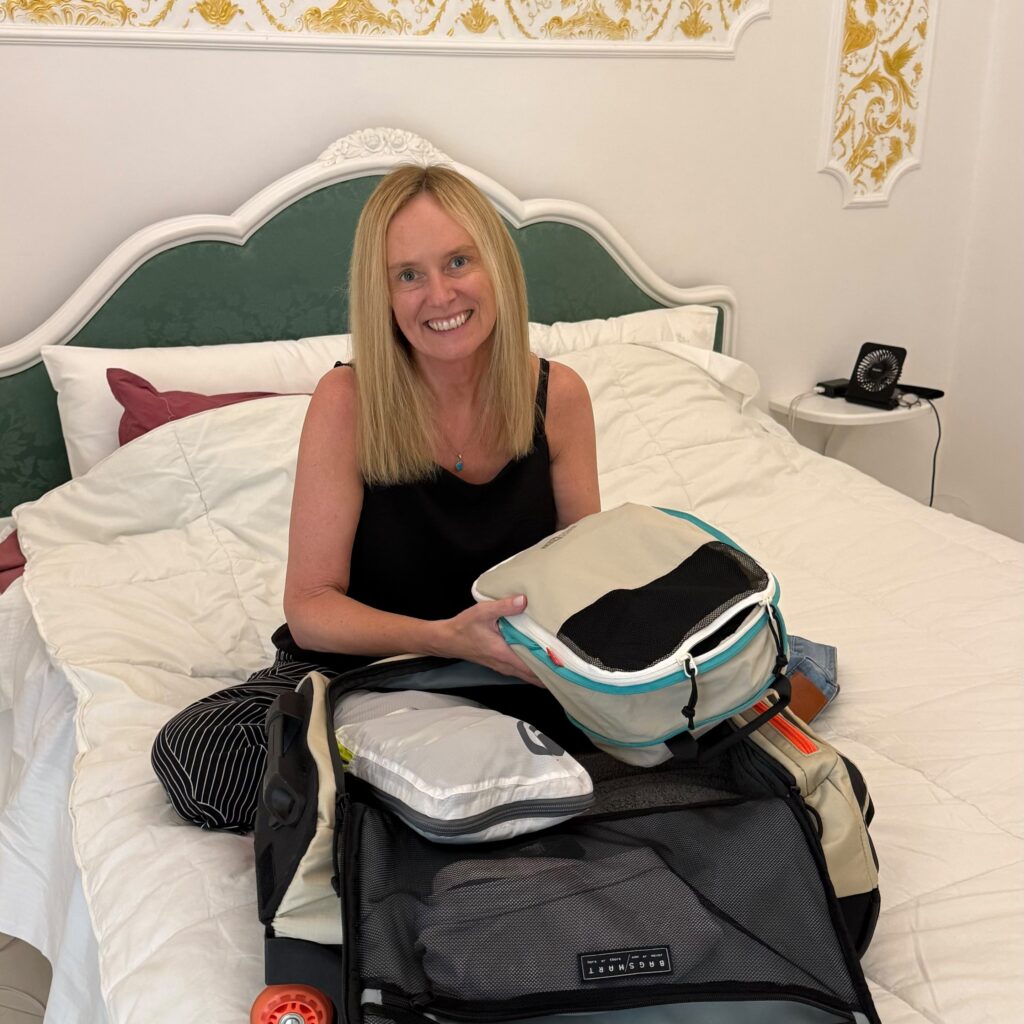
Packing cubes are drawers, not vacuum bags
We both resisted cubes at first. They looked like a gimmick.
I came around immediately. Matt hated them for ages, because he was overstuffing them, fighting the zippers, and then giving up and letting his carry-on turn into a wrinkled pile after one night of digging for a single shirt.
Here’s what fixed it for him, and it’s the thing nobody explains properly: cubes aren’t really about fitting more in. They’re portable drawers you never have to unpack. Once he stopped trying to compress everything, they became one of the few pieces of gear we’d replace immediately if we lost them.
Pack by use case, not by garment. Most people do a cube for shirts, a cube for pants, a cube for underwear. It sounds logical and it’s miserable on the road. Instead: a daywear cube, an eveningwear cube, a beachwear cube, a workout or sleep cube if that’s your thing.
Then live out of one or two. Unzip the cubes you’re using now and treat them as drawers. Leave the rest zipped. When you move on, zip up and go. You stay organized without unpacking your whole bag in every new place.
Don’t overstuff. If you’re wrestling the zipper, you put too much in. Compression’s optional. Organization’s the whole point.
For a city-hopping trip I run three: daywear, a second daily option for weather, and eveningwear that stays zipped until it’s needed. For a beach trip it’s swimwear, socks and underwear, and one nicer outfit left sealed.
These are the cubes we’re using now. Compression versions exist if you want them, though after all this I’d say compression’s a bonus rather than the reason. And if you’re settling somewhere for more than a few nights, packing shelves are worth a look as an alternative.
What to leave at home
This is where most of the space goes, and almost none of it’s missed.
The beach towel. It takes up half your bag and dries slower than you do. Hotels and Airbnbs have towels. If yours doesn’t, buy a cheap one locally and leave it behind.
The hair dryer. Almost every place you’ll stay has one. Bringing your own abroad is a genuinely good way to blow a fuse or fry your hair, because the voltage is different and an adapter doesn’t fix that. I’ve seen it happen. If it really matters to you, check the amenities before you book. In all our years of travel I’ve never once regretted leaving mine home.
Full-size toiletries. Security will take them anyway, and even in a checked bag shampoo leaks. Travel sizes, or buy them when you land. Somewhere like Europe or Asia the local stuff is often better. Soap sheets weigh nothing and can’t spill at all, and if you’re decanting your own, silicone bottle covers are cheap insurance against opening your bag to a disaster.
Anything valuable. No good jewelry, nothing sentimental, nothing you’d be sick about losing. I travel with one pair of earrings and a simple bracelet that look nice and are worth nothing. If they vanish, I don’t care. We were burgled in Cyprus and the earrings I had with me went, along with my wallet and my scarf, and I’ve been grateful ever since that they weren’t the ones that mattered.
“Just in case” anything. Just in case it rains for seven days. Just in case we go hiking. Just in case there’s a gala. Those things almost never happen and the gear always comes home unused. The best packing advice we got when we started came from Erin and Simon at Never Ending Voyage: lay everything out and ask yourself what you plan to use it for, and if it’s for a just-in-case scenario, ditch it. Everything has to earn its place by being used regularly.
Extra bags. You need one. Not a big purse, a small purse, a clutch, a belt bag and a tote. One well-chosen crossbody or anti-theft bag that’s light, neutral and secure enough for a busy street. Mine has a zip closure, an adjustable strap and just enough room for a phone, a wallet, lip balm, sunglasses and tissues. Switching bags wastes time and it’s how things get left behind.
Most gadgets. We’ve bought, packed and ditched more travel tech than I can count. Some of it sounded brilliant and then broke, or took up too much space, or sat untouched in the bag while we reached for the same few things over and over. What tends to last is whatever does more than one job: a charging cord that handles everything, a power bank, and a pillow that stuffs down flat rather than hanging off the outside of your bag.
You’re not packing for the whole trip
This is the mindset shift that makes the rest possible.
You don’t need seven outfits for seven days. You need a small set of mix-and-match pieces, and then you wash things. If something gets dirty, I wash it. If I wear the same outfit twice, nobody notices, and if they do, I’ve never once cared. You’re not trying to impress strangers you’ll never see again.
A packet of sink detergent weighs nothing and takes up no room, and it’s what makes the difference between packing for a week and packing for however long you’re actually gone.
What goes under the seat
Your personal item’s small but it pulls a lot of weight.
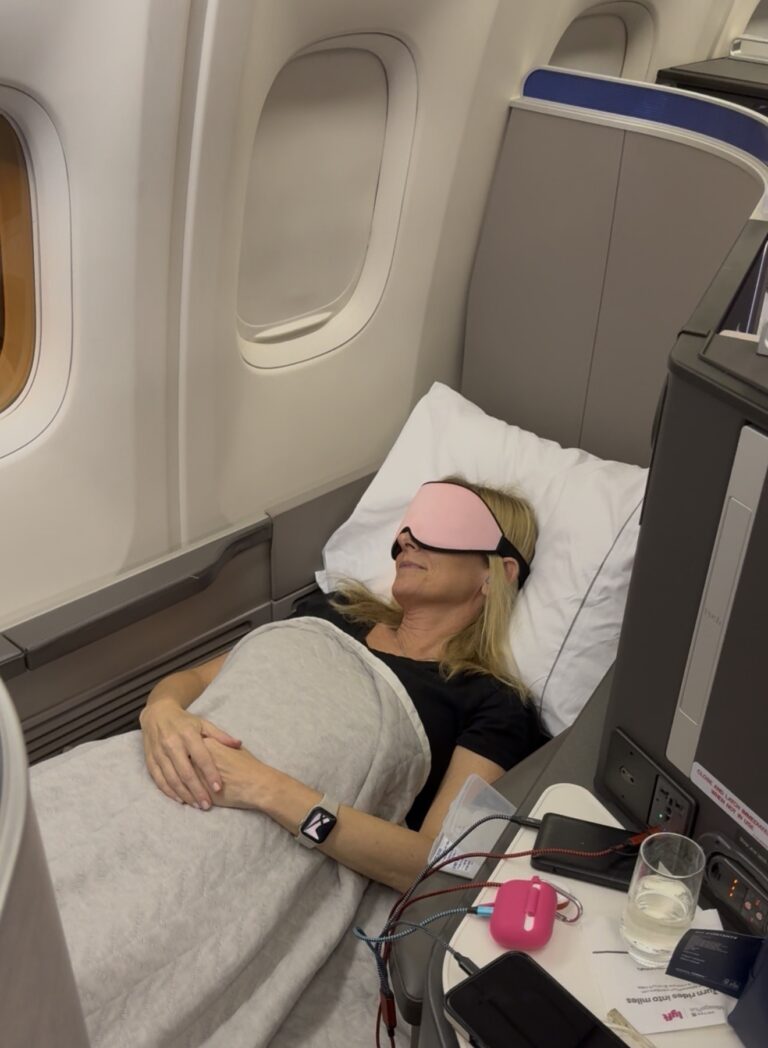
Everything you’ll actually want between leaving home and reaching your room lives there: documents, medications, a snack, headphones, a layer for the plane, chargers, water. If it’s in the overhead bin you won’t get to it, so it isn’t really with you.
Ours is usually a small backpack that doubles as a day bag once we arrive, which is one fewer thing to pack. It needs to be lightweight, compact and comfortable to carry, because you’ll have it on for hours.
What this actually buys you
We’ve walked miles through train stations and over cobblestones without once wishing we had more stuff.
Carrying less saves money on bag fees and time at baggage claim, and it removes the entire category of worry about whether your things made the same flight you did. But the real return’s smaller and better than that. Fewer decisions. A bag you can lift yourself. Stairs you don’t dread. The freedom to change plans without a production.
You don’t need more space. You need fewer, better things.
Use My Free Packing Guide and App
I made the checklist version of all of this, and it’s free.
The Ready Jet Roam Packing Guide is eleven pages: how to choose the bag, the cube system, the clothes that do double or triple duty, the shoe rule, toiletries, what to leave home, what belongs in your personal item, and the final prep before you go.
It’s the version you pack from, rather than the version you read once.
Send me the free Packing Guide
And if you’d rather not think about any of it, my packing app does the thinking for you. It asks where you’re going, what the weather’s like, how many nights, whether there’ll be swimming or anything dressy, and whether you’ll have laundry access. Then it builds your list and you print it or save it.
It’s free, no signup, and nothing to buy. Build my packing list
Frequently asked questions
Do packing cubes actually save space? Sometimes a little, especially with compression. But that’s not the reason to use them. The real win is that you stop living out of a chaotic pile every time you change hotels.
Should I pack cubes by clothing type? You can, but it usually creates more mess on the road. Packing by daywear, eveningwear and beachwear makes it easier to grab what you need and keep the rest zipped.
Are compression cubes worth it? Yes, but only if you use them without overstuffing. Compression’s a nice bonus. Organization’s the real reason to use cubes at all.
How many cubes do I need for a carry-on? Most people do well with three to six, depending on trip length and whether you organize by outfit type or by category.
What if it’s cold where I’m going? Layers, not bulk. A base layer, a long sleeve, an ultralight puffer and a scarf has taken us through snow, wind, mountain towns and northern Europe in spring. The mistake’s the big coat, which you’ll wear on the plane and then carry around for two weeks.
What about the things I might need? That’s the one to be ruthless about. If you’re packing for a situation you’ve imagined but probably won’t happen, don’t. Those items almost always go unused. If something unexpected comes up you can nearly always buy it locally, whether it’s an umbrella, a pair of leggings or a nicer outfit.
Isn’t it stressful wearing the same things repeatedly? It’s the opposite. Fewer decisions in the morning, a bag you can carry up stairs on your own, and no anxiety about whether your luggage arrived. The stress is in the stuff.
Does this work if I’m not traveling full time? That’s most of the people who ask me, and yes. Nothing here depends on being gone for years. The colors, the cubes, the three pairs of shoes and the willingness to wash something all work exactly the same on a two-week trip.
The bottom line
I still pack the same way I did on the trip where I finally got it right. Two or three colors. Five tops, three bottoms, one pair of jeans worn on the plane. Three pairs of shoes. Cubes packed by what I’ll be doing rather than what the clothes are. Everything else bought on the road if I turn out to need it, which I usually don’t.
And when Matt couldn’t lift anything heavier than five pounds, we checked a bag and took all the help we could get, and the system underneath was still the right one. That’s the part I’d wantyou to take away. It isn’t a rule you can fail at. It’s a default that makes almost every day of a trip easier, and it bends when your life needs it to.
Start with the bag and the colors. The rest follows.
Subscribe to my newsletter!
I send one email a week to over 21,000 subscribers. Real stories, what worked, what didn’t, and the practical things I only figure out by doing them. Plus the free packing guide and the international travel checklist when you sign up.
NEXT STEP
Get the free Packing Guide. Eleven pages, built to pack from. Send it to me
Or skip straight to the list: build one for your trip in the packing app.
Follow Me!
Follow us on the socials for smart, real-world travel tips based on what we’ve actually learned out there. Follow us on:
TikTok
Facebook
Instagram
3 comments
Glad you are not 25 because tips for people that young don
Glad you are not 25 because tips for people that young don
Glad you are not 25 because tips for people that young don